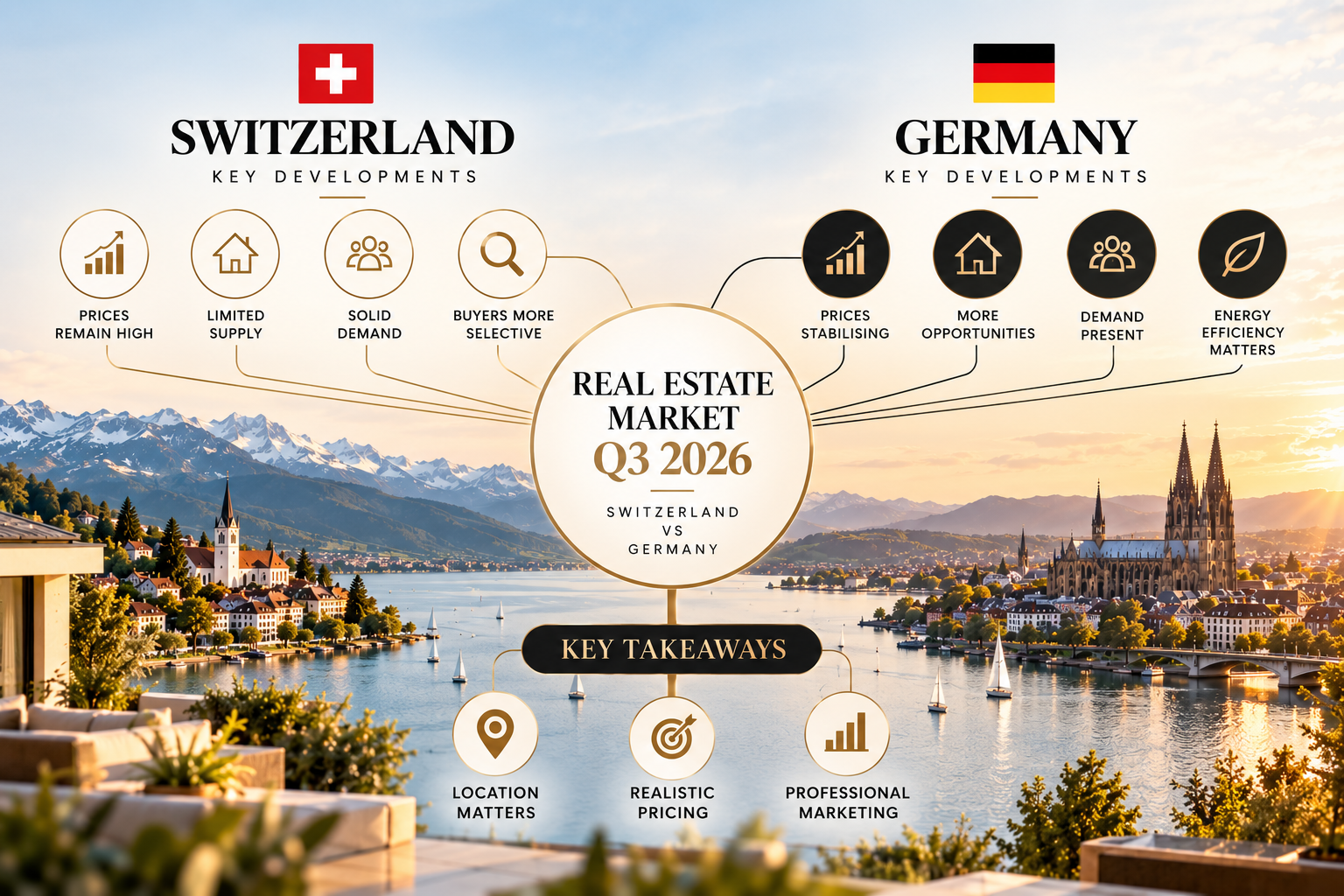







Two neighbouring countries. Two different real estate markets.
Switzerland and Germany are both showing resilient residential property markets in 2026, but they are entering the final months of the year from very different starting points.
Switzerland continues to be characterised by high property prices, limited supply and strong demand for residential ownership. Germany, meanwhile, has moved further into a period of price stabilisation following the correction of previous years.
For property owners, buyers and international investors, understanding these differences is becoming increasingly important.
Switzerland: High Prices and Limited Supply
The Swiss residential property market remains strong.
According to the latest available Raiffeisen transaction data, prices for single-family homes in Q2 2026 were 3.4% higher than one year earlier.
Condominium prices increased even more, rising 4.2% year-on-year. Compared with the previous quarter, condominium prices increased by another 1.0%, while single-family home prices remained stable at a high level.
Limited supply remains one of the key factors supporting the Swiss market.
At the same time, there are signs that the exceptional momentum of recent years is beginning to moderate.
High entry prices and financing requirements are limiting the number of households able to purchase residential property. Buyers remain active, but they are becoming increasingly selective.
This creates an interesting situation for sellers.
Demand continues to exceed supply in many locations, but a strong overall market does not automatically guarantee the highest possible selling price for every property.
Germany: The Market Continues to Stabilise
Germany presents a different picture.
Following the significant market adjustment triggered by higher financing costs, residential property prices have increasingly stabilised.
The Europace House Price Index for August 2026 was 1.68% higher than one year earlier.
However, the individual market segments developed differently.
Prices for newly built single and two-family homes increased by 3.34% year-on-year.
Existing single and two-family homes were 1.26% above the previous year's level.
Condominium prices increased by only 0.26%.
These differences illustrate an important characteristic of the German market in 2026: the recovery is not uniform.
Location, property type, condition and energy efficiency can significantly influence both demand and achievable prices.
Switzerland vs Germany: Two Different Starting Points
The Swiss market continues to be shaped by structural scarcity.
Residential property remains difficult to access for many households, while limited construction activity restricts supply. This supports property values, particularly in attractive locations.
Germany is further advanced in a market adjustment cycle.
Prices corrected after the rapid increase in financing costs and are now showing signs of renewed stability and moderate growth in several segments.
The result is two different market environments.
Switzerland:
High price levels, limited supply and continued demand.
Germany:
Stabilising prices, greater buyer choice in some regions and stronger differentiation between individual properties.
Yet both markets share one important development.
Buyers are becoming more selective.
Location Matters More Than National Averages
National property indices provide valuable orientation, but they cannot determine the value of an individual property.
Regional differences remain substantial in both countries.
A condominium in Zurich, a house near Lake Constance or a property in Eastern Switzerland can follow a very different price trend from the national average.
The same applies in Germany.
Property markets in Munich, Berlin, Hamburg or Frankfurt differ significantly from regional markets in Southern Germany.
The Lake Constance region is particularly interesting because the Swiss and German property markets meet within a relatively small geographical area.
Cities and municipalities around Konstanz, Kreuzlingen, Radolfzell and the wider Lake Constance region are influenced by local supply, cross-border employment, infrastructure and the attractiveness of the region as a place to live.
For property owners, this makes local market knowledge increasingly important.
Energy Efficiency Is Becoming More Relevant
Another difference between individual properties is becoming increasingly visible: energy efficiency.
This is particularly relevant in Germany, where buyers often calculate potential renovation and modernisation costs before submitting an offer.
Older heating systems, insulation standards and expected renovation requirements can directly influence a buyer's willingness to pay.
For sellers, this does not necessarily mean that major renovations should be completed before selling.
Instead, the condition of the property should be reflected transparently in the valuation and pricing strategy.
The same principle increasingly applies to Switzerland, where property condition, construction quality and future investment requirements also influence buyer decisions.
What Does This Mean for Property Sellers?
The current market environment remains favourable for well-positioned properties.
However, the days when a rising market could compensate for almost any pricing strategy are increasingly over.
A successful property sale should therefore begin with three questions:
What is the property realistically worth in its local market?
Who is the most likely buyer?
How should the property be positioned to generate the strongest possible demand?
This is particularly important for higher-value properties.
As prices increase, the number of potential buyers who can finance a purchase naturally becomes smaller. Correct positioning therefore becomes increasingly important.
The Asking Price Is Only the Starting Point
One of the most common misunderstandings in residential real estate is the assumption that a higher asking price automatically leads to a higher selling price.
In practice, the relationship is more complex.
An asking price needs to create sufficient market interest while protecting the value of the property.
If a property enters the market significantly above buyer expectations, valuable momentum during the first weeks of marketing can be lost.
If several qualified buyers are interested at the same time, the seller is generally in a much stronger negotiating position.
This principle applies in both Switzerland and Germany.
Outlook for the Remainder of 2026
The Swiss residential property market remains supported by limited supply and comparatively favourable financing conditions, although the pace of growth is showing signs of moderation.
Germany continues its stabilisation, with the latest transaction data showing moderate year-on-year price increases across the overall market and stronger growth in new residential construction.
For buyers, sellers and investors, this means that broad national market movements are becoming less important than the characteristics of the individual property.
Micro-location, property condition, energy efficiency, target buyers and local competition increasingly determine the achievable result.
Thinking About Selling Property in Switzerland or Germany?
A professional property valuation should go beyond a general price-per-square-metre calculation.
ImmoLeague analyses the property, its location, comparable transactions, current competition and the relevant buyer market before developing an individual sales strategy.
Our objective is not to establish the highest theoretical asking price.
It is to achieve the best possible price that the market can realistically support.
ImmoLeague
Switzerland | Germany | International