






Global interest rate markets are moving again.
On September 16, 2026, the US Federal Reserve raised the target range for the federal funds rate by 0.25 percentage points to 3.75% to 4.00%.
The decision sends a clear signal that inflation remains a key concern for US monetary policy. At the same time, a comparison with the Eurozone and Switzerland reveals just how different interest rate environments have become across major international real estate markets.
For international property buyers and investors, these differences matter. Financing costs, exchange rates, required returns and the attractiveness of individual property markets are all influenced by the prevailing interest rate environment.
USA: Fed Raises Rates to 3.75% to 4.00%
The Federal Open Market Committee unanimously approved the rate increase.
The Federal Reserve continues to describe US economic activity as solid, while inflation remains elevated.
For the US real estate market, one immediate consequence is clear: financing remains comparatively expensive.
This is particularly relevant for high-value properties. Even relatively small changes in interest rates can have a significant impact on monthly payments and total financing costs.
Three Economic Regions, Three Different Interest Rate Environments
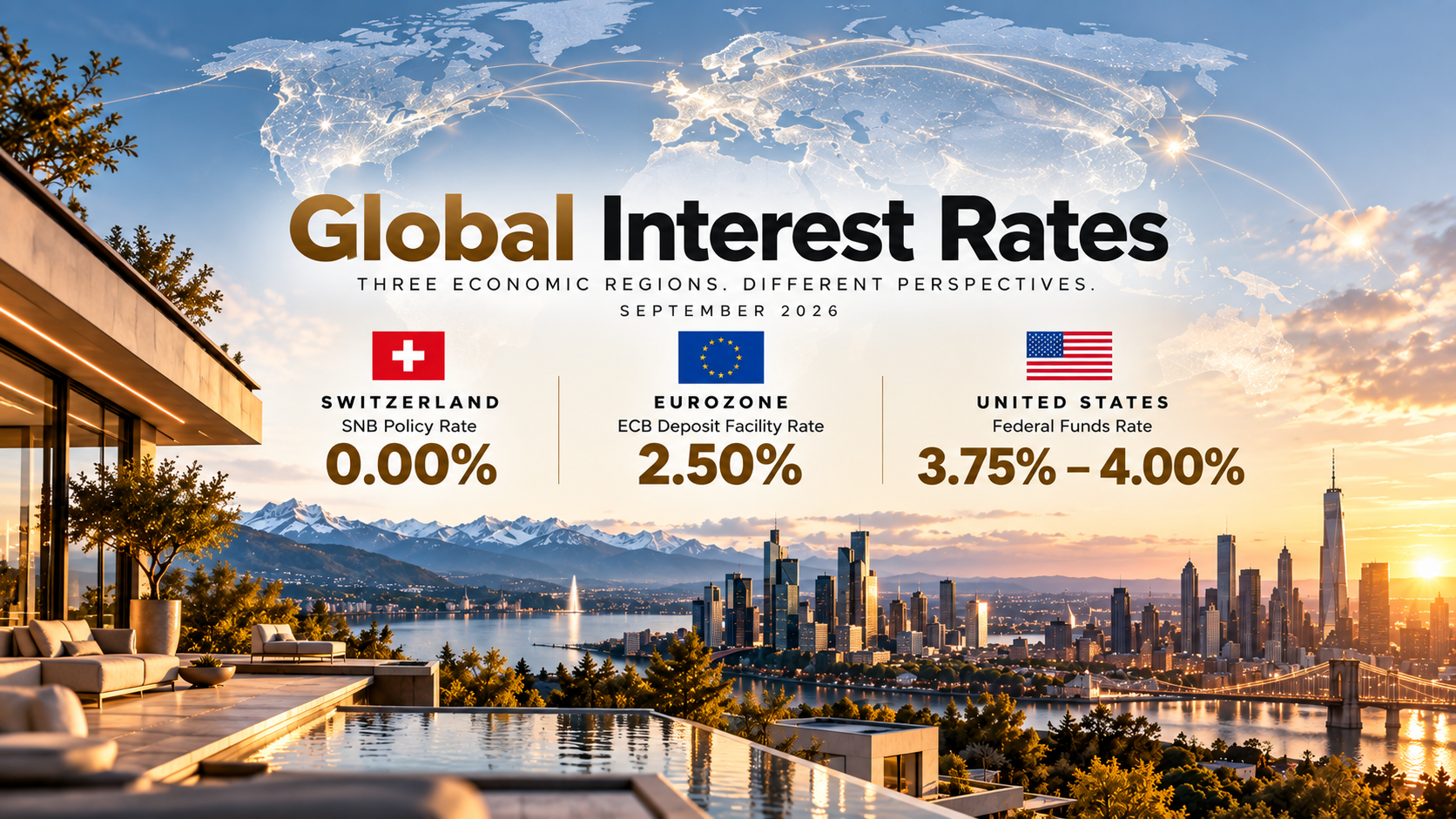
The international comparison is particularly striking in September 2026:
Switzerland
SNB Policy Rate: 0.00%
Eurozone
ECB Deposit Facility Rate: 2.50%
United States
Federal Funds Rate: 3.75% to 4.00%
These figures highlight substantial differences between three major economic regions.
While the Swiss National Bank kept its policy rate unchanged at 0.00% on September 24, the European Central Bank raised its key interest rates by 0.25 percentage points in September. The Federal Reserve also increased its target range by 0.25 percentage points.
What Does This Mean for International Property Buyers?
The purchase price alone is not enough to compare international real estate opportunities.
The total cost of capital matters.
A market with higher property prices may still be economically attractive if financing costs are low. Conversely, a property that initially appears less expensive can become considerably more costly when higher interest rates are taken into account.
Currency exposure, taxes, running costs and regulatory requirements also need to be considered.
International buyers should therefore evaluate the property price and its financing as part of the same investment decision.
Switzerland: A Distinct Interest Rate Environment
With an SNB policy rate of 0.00%, Switzerland currently stands apart from both the Eurozone and the United States.
Low interest rates generally support property financing and can help sustain demand for residential real estate.
At the same time, supply remains limited in many sought-after Swiss locations.
For international buyers, however, this does not automatically make Swiss real estate cheaper or more attractive. High property prices, regulations affecting foreign purchasers and movements in the Swiss franc all need to be included in the overall assessment.
Eurozone: Financing Costs Are Rising Again
The European Central Bank raised its three key interest rates by 0.25 percentage points in September.
The deposit facility rate now stands at 2.50%, the main refinancing operations rate at 2.65% and the marginal lending facility rate at 2.90%.
This places the Eurozone between Switzerland and the United States in terms of current policy rates.
However, there is no single European real estate market.
Germany, Spain, Portugal and other European markets differ considerably in terms of property prices, demand, new construction, financing conditions and economic development.
International investors should therefore assess individual countries, regions and locations rather than treating Europe as one homogeneous property market.
United States: Higher Capital Costs Change the Calculation
With the federal funds rate at 3.75% to 4.00%, the US interest rate environment is considerably higher than in Switzerland and the Eurozone.
For real estate investors, this increases the importance of yield and cash flow.
As financing costs rise, an investment needs to justify its capital requirements through rental income, potential appreciation or other economic advantages.
Higher rates may also create opportunities if fewer highly leveraged buyers are able or willing to compete for properties.
However, higher interest rates do not automatically result in falling property prices. Supply, demand, location and economic conditions remain important drivers of individual real estate markets.
What Does the New Interest Rate Environment Mean for Investors?
International real estate investments require careful calculation in the current environment.
In addition to the purchase price, investors should consider financing costs, equity requirements, currency exposure, taxation, rental yields, operating costs and the intended holding period.
The currency in which income is generated and financing is arranged is also increasingly important.
A Swiss investor purchasing property in the United States or the Eurozone, for example, may face currency exposure in addition to the risks directly associated with the property.
Our Assessment
The latest decisions by the Fed, ECB and SNB demonstrate that there is currently no uniform global interest rate trend.
Switzerland maintains a policy rate of 0.00%.
The Eurozone has tightened monetary policy, with the ECB deposit facility rate now at 2.50%.
In the United States, the federal funds target range stands at 3.75% to 4.00%.
These differences create very different conditions for property buyers and investors.
The key question is therefore not which market is generally the best.
The relevant question is whether a specific property makes sense when its purchase price, financing, location, currency exposure, potential return and the investor's individual strategy are considered together.
For anyone investing internationally in real estate, looking beyond the purchase price has become increasingly important.
ImmoLeague International
Real estate in Switzerland, Germany and selected international markets.
Buy. Sell. International.